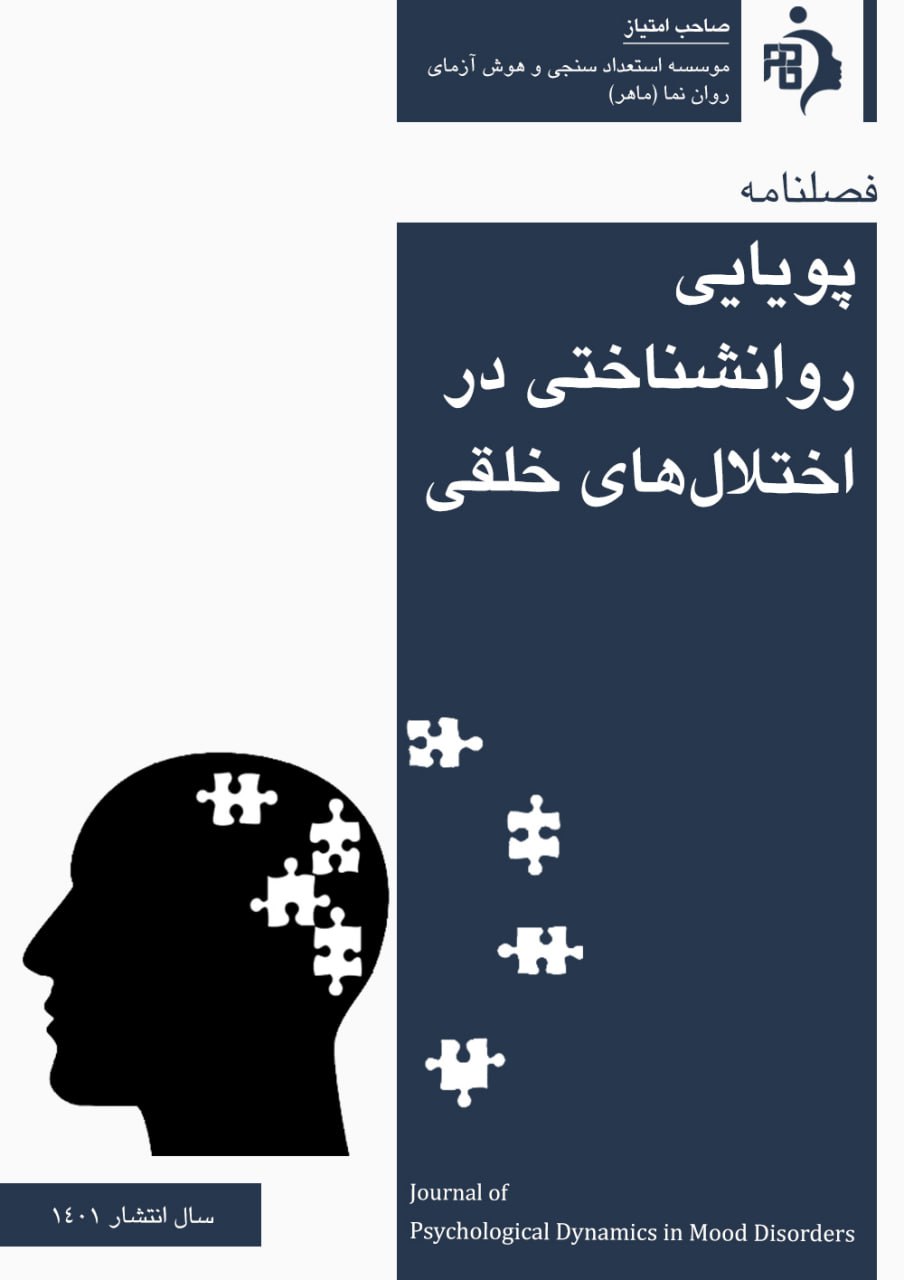
اثربخشی آموزش مهارت‌های مثبت‌اندیشی با تاکید بر آموزه‌های دینی بر تاب‌آوری و مدیریت خشم در مادران کودکان مبتلا به اختلال یادگیری

نویسندگان

    مرضیه سلطانی دانشجوی دکتری مشاوره، گروه امور تربیتی و مشاوره، واحد قم، دانشگاه آزاد اسلامی، قم، ایران.
    عبدالوحید داودی * استادیار، گروه روانشناسی، واحد قم، دانشگاه آزاد اسلامی، قم، ایران (نویسنده مسئول). v1364174@gmail.com
https://doi.org/10.61838/kman.pdmd.3.3.12

کلمات کلیدی:

مهارت‌های مثبت‌اندیشی, آموزه‌های دینی, تاب‌آوری, مدیریت خشم, اختلال یادگیری

چکیده

زمینه و هدف: مادران کودکان مبتلا به اختلال یادگیری با چالش‌های فراوانی به‌ویژه در زمینه‌های تاب‌آوری و مدیریت خشم مواجه هستند و با توجه به بافت فرهنگی و مذهبی کشور ایران به نظر می‌رسد که آموزش مهارت‌های مثبت‌اندیشی با تاکید بر آموزه‌های دینی در این زمینه اثربخش باشد. در نتیجه، پژوهش حاضر با هدف تعیین اثربخشی آموزش مهارت‌های مثبت‌اندیشی با تاکید بر آموزه‌های دینی بر تاب‌آوری و مدیریت خشم در مادران کودکان مبتلا به اختلال یادگیری انجام شد.

روش و مواد: این پژوهش از نظر هدف، کاربردی و از نظر شیوه اجرا، نیمه‌آزمایشی با طرح پیش‌آزمون و پس‌آزمون همراه با گروه کنترل بود. جامعه آماری مطالعه مادران کودکان مبتلا به اختلال یادگیری منطقه 16 تهران در سال 1402 بودند. نمونه پژوهش 30 نفر بودند که با روش نمونه‌گیری هدفمند انتخاب و به‌صورت تصادفی در دو گروه مساوی گمارده شدند. گروه آزمایش 10 جلسه 90 دقیقه‌ای تحت آموزش مهارت‌های مثبت‌اندیشی با تاکید بر آموزه‌های دینی قرار گرفت و در این مدت گروه کنترل هیچ مداخله‌ای دریافت نکرد. ابزارهای پژوهش شامل مقیاس تاب‌آوری کانور و دیویدسون (2003) و سیاهه مدیریت خشم اسپیلبرگر (1999) بود و داده‌های آن با روش تحلیل کوواریانس چندمتغیری در نرم‌افزار SPSS نسخه 25 تحلیل شدند.

یافته‌ها: یافته‌ها نشان داد که آموزش مهارت‌های مثبت‌اندیشی با تاکید بر آموزه‌های دینی باعث افزایش تاب‌آوری و مدیریت خشم در مادران کودکان مبتلا به اختلال یادگیری شد (05/0P<).

نتیجه‌گیری: طبق نتایج این مطالعه، برای بهبود تاب‌آوری و مدیریت خشم می‌توان از روش آموزش مهارت‌های مثبت‌اندیشی با تاکید بر آموزه‌های دینی در کنار سایر روش‌های آموزشی استفاده کرد.

دانلودها

دسترسی به دانلود اطلاعات مقدور نیست.

مراجع

Aghajani, M. J., Hosain Khanzadeh, A., Akbari, B., & Mirarzgar, M. S. (2017). The effect of the Islamic positive

thinking training on anger management and life satisfaction in mothers of exceptional children. Middle Eastern

Journal of Disability Studies, 7(32), 1-6. https://jdisabilstud.org/article-1-676-en.pdf

Akbari, T., & Porzoor, P. (2020). The effectiveness of positive thinking skills training with emphasis on religious

teachings on resilience and life satisfaction of parents of children with learning disabilities. Journal of Learning

Disabilities, 10(1), 7-31. https://jld.uma.ac.ir/article_1042.html?lang=en

Alshammari, M. H., & Alboliteeh, M. (2022). Predictors and correlates of Saudi nursing students' grit and positive

thinking amidst the COVID-19 pandemic. Teaching and Learning in Nursing, 17(4), 471-476.

https://doi.org/10.1016/j.teln.2022.06.012

Ambika, A., Vijayasamundeeswari, P., & David, A. (2019). Effectiveness of planned teaching program among

primary school teachers regarding awareness of learning disabilities in children. Journal of Family Medicine

and Primary Care, 8(12), 3845-3849. https://doi.org/10.4103/jfmpc.jfmpc_722_19

Connor, K. M., & Davidson, J. R. T. (2003). Development of a new resilience scale: The Connor-Davidson

resilience scale (CD-RISC). Depression and Anxiety, 18(2), 76-82. https://doi.org/10.1002/da.10113

Danesh, E., Manavishad, M., Khoushabi, K., Hasanzadeh Tavakoli, M. (2014). The impact anger level and

childrearing styles of mothers on self-concept of their children with or without LD. Journal of Family Research,

10(2), 175-196. https://jfr.sbu.ac.ir/article_96567.html?lang=en

Donohue, E., Halgunseth, L. C., Chilenski, S. M., & Perkins, D. F. (2022). Recurring parent-child conflict: A

mediator between parental anger management and adolescent behavior. Family and Consumer Sciences

Research Journal, 51(1), 6-19. https://doi.org/10.1111%2Ffcsr.12450

Ghanaeian, M., Banisi, P., & Zomorrody, S. (2022). The effectiveness of mindfulness training on lifestyle, anger

management and self-compassion in students of West Tehran University. Journal of New Approach to

Children’s Education, 4(2), 146-155. https://doi.org/10.22034/naes.2022.331704.1177

Gonzalez-Gomez, A. L., Farrington, D. P., & Llorent, V. J. (2021). Descriptive and quasi-experimental studies

about moral emotions, online empathy, anger management, and their relations with key competencies in primary

education. International Journal of Environmental Research and Public Health, 18(11584), 1-16.

https://doi.org/10.3390/ijerph182111584

Hart, T., Vaccaro, M. J., Fann, J. R., Maiuro, R. D., Neuberger, Sh., & Sinfield, S. (2020). Psychoeducational

interventions for problematic anger in chronic, moderate to severe traumatic brain injury: A study of treatment

enactment. Journal of the International Neuropsychological Society, 26(1), 119-129.

https://doi.org/10.1017%2FS1355617719000833

Higuita-Gutierrez, L. F., Estrada-Mesa, D. A., & Cardona-Arias, J. A. (2022). The relation of ideology of positive

thinking with the perception of cancer risk and ways of treating it in Medellin, Colombia. Psychology Research

and Behavior Management, 15, 3329-3345. https://doi.org/10.2147/prbm.s380641

Hosseini, S. A. (2024). Comparison of the effectiveness of cognitive behavioral therapy and schema therapy on

emotional regulation and resilience of mothers with children with attention deficit/hyperactivity disorder.

Journal of Psychological Dynamics in Mood Disorders, 3(1), 12-29.

https://ijpdmd.com/article_196560.html?lang=en

Karami, M. (2014). Investigating the effect of group training of anger control skills based on Islamic teachings on

students' aggression. Journal of Research in Islamic Education Issues, 22(1), 99-114.

https://iej.ihu.ac.ir/article_200868.html

Khosravi, F. (2019). The effectiveness of teaching positive thinking skills with emphasis on religious teachings on

the motivation of progress and self-efficacy. Sociology of Education, 5(2), 89-101. https://www.iase

jrn.ir/article_43752_en.html

Liao, Z., Zhou, H., & He, Z. (2022). The mediating role of psychological resilience between social participation

and life satisfaction among older adults in China. BMC Geriatrics, 12(948), 1-16.

https://doi.org/10.1186/s12877-022-03635-x

Maleki Gholandoz, P., & Sardary, B. (2021). The effectiveness of positive psychology training with emphasis on

religious doctrines on reducing students’ high-risk behaviors with suicidal thoughts. Positive Psychology

Research, 6(3), 51-68. https://doi.org/10.22108/ppls.2021.122201.1907

McKenna, O., Fakolado, A., Cardwell, K., Langlois, N., Jiang, K., & Pilutti, L. A. (2022). Towards conceptual

convergence: A systematic review of psychological resilience in family caregivers of persons living with chronic

neurological conditions. Health Expectations, 25(1), 4-37. https://doi.org/10.1111/hex.13374

Mohammadi Armandi, M., & Mottaqi, M. (2022). Experiences of parents of students with learning disabilities in

elementary schools in Lordegan, Iran, in 2020. Avicenna Journal of Nursing and Midwifery Care, 30(3), 221

230. http://dx.doi.org/10.32592/ajnmc.30.3.221

Naeimi, E., Shafiabadi, A., & Davoodabadi, F. (2017). The impact of training positive thinking skills with emphasis

on religious teachings on resilience and vocational interest of students of Chahardangeh country high schools.

Counseling Culture and Psychology, 7(28), 1-31. https://doi.org/10.22054/qccpc.2017.7089

Noordin, N., Abdullah, N. N., & Yunus, R. M. (2024). Psychological resilience among orang asli youths in Selangor

during COVID-19 and its associated factors. The Malaysian Journal of Medical Sciences, 31(3), 204-216.

https://doi.org/10.21315%2Fmjms2024.31.3.16

Novin, J., & Bahrami Ehsan, H. (2017). Designing and evaluation of religious-psychological training package on

communicative skills and control of aggression. Clinical Psychology Studies, 7(26), 1-23.

https://doi.org/10.22054/jcps.2017.7389

Poursalman, S., & Asgharnejad Farid, A. (2020). The effectiveness of life skills training on anger management and

resilience in adolescents. Journal of Applied Family Therapy, 1(2), 105-124.

https://doi.org/10.22034/aftj.2020.118745

Rajesh, R., & Joseph, Z. C. (2023). Competency-based teacher education (CBTE): A training module to improve

knowledge, attitude, and practices (KAP) of school teachers on learning disabilities in children. Journal of

Family Medicine and Primary Care, 12(5), 874-880. https://doi.org/10.4103/jfmpc.jfmpc_580_22

Rashidzadeh, A., Beyrami, M., Hashemi NosratAbad, T., & Mirnasab, M. (2019). The effect of teaching positive

thinking skills based on spiritual resources and religious beliefs on resilience and psychological well-being of

mothers with autistic children. Journal of Woman & Study of Family, 11(43), 59-83.

http://dx.doi.org/10.29252/qaiie.3.2.59

Sarid, M., & Lipka, O. (2023). Students with learning disabilities/attention-deficit/hyperactivity disorder in higher

education dealing with remote learning: lessons learned from COVID-19 era. Frontiers in Psychology,

20(1172771), 1-12. https://doi.org/10.3389/fpsyg.2023.1172771

Shorey, R. C., McNulty, J. K., Moore, T. M., & Stuart, G. L. (2017). Trait anger and partner-specific anger

management moderate the temporal association between alcohol use and dating violence. Journal of Studies on

Alcohol and Drugs, 78(2), 313-318. https://doi.org/10.15288/jsad.2017.78.313

Singh, K. K., & Kumar, A. (2022). Resilience in mothers having children with disabilities. Chettinad Health City

Medical Journal, 11(3), 23-29. https://doi.org/10.24321/2278.2044.202225

Sorella, S., Vellani, V., Siugzdaite, R., Feraco, P., & Grecucci, A. (2022). Structural and functional brain networks

of individual differences in trait anger and anger control: An unsupervised machine learning study. European

Journal of Neuroscience, 55(2), 510-527. https://doi.org/10.1111/ejn.15537

Spielberger, C. D. (1999). STAXI-2 state-trait anger expression inventory-2:

Professional manual. Odessa: Psychological Assessment Resources Publisher.

https://www.scirp.org/reference/referencespapers?referenceid=1501682

Su, P., Yi, J., Chen, X., & Xiao, Y. (2023). Visual analysis of psychological resilience research based on web of

science database. Psychology Research and Behavior Management, 16, 465-481.

https://doi.org/10.2147/prbm.s394693

Tiengsomboon, U., & Luvira, V. (2024). Family support for children with learning disabilities to attain good

academic performance: A qualitative study. Malaysian Family Physician, 19(25), 1-9.

https://doi.org/10.51866%2Foa.529

Yekanizad, A., Soleimannezhad, A., Hajizadeh, N., & Manzari, M. (2022). The effectiveness of the teaching

positive thinking skills with emphasis on religious teachings happiness and Psychological well –being of

students. Journal of Educational Psychology, 13(3), 73-89.

https://sanad.iau.ir/en/Journal/psyedu/Article/700470?jid=700470

دانلود

چاپ شده

۱۴۰۳/۰۷/۱۵

ارسال

۱۴۰۳/۰۴/۱۰

بازنگری

۱۴۰۳/۰۶/۱۵

پذیرش

۱۴۰۳/۰۷/۰۲

شماره

نوع مقاله

مقالات

ارجاع به مقاله

سلطانی م.، و داودی ع. (1403). اثربخشی آموزش مهارت‌های مثبت‌اندیشی با تاکید بر آموزه‌های دینی بر تاب‌آوری و مدیریت خشم در مادران کودکان مبتلا به اختلال یادگیری. پویایی روانشناختی در اختلال های خلقی، 3(3)، 145-155. https://doi.org/10.61838/kman.pdmd.3.3.12

مقالات مشابه

1-10 از 307

همچنین برای این مقاله می‌توانید شروع جستجوی پیشرفته مقالات مشابه.